
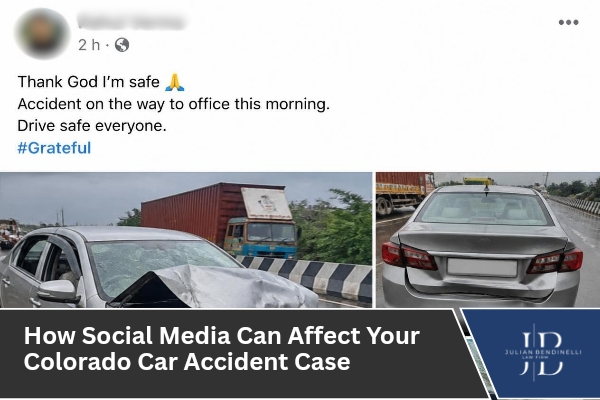
After a car accident, posting online may feel completely normal.
You may want to let friends know you are okay, explain what happened, thank people for checking on you, or share updates about your recovery.
But social media can become part of an injury claim.
A car accident attorney Colorado injury victims speak with may ask about Facebook, Instagram, TikTok, X, LinkedIn, and other accounts because insurance companies may review publicly available information when evaluating a claim.
That does not mean you should panic or assume every post will hurt your case.
It does mean you should understand how online activity may be interpreted before sharing information about the accident, your injuries, or your recovery.
Why Social Media Can Matter After a Car Accident
A personal injury claim often involves questions about what happened and how the accident affected your life.
Insurance companies may look for information that they believe supports or challenges what you are saying.
Social media can provide photographs, videos, comments, location information, and other details about your activities.
A single post may not tell the full story.
Still, an insurer may try to use it that way.
For example, a photograph showing you smiling at a family gathering does not necessarily mean you were pain-free. You may have attended for an hour and spent the rest of the day recovering.
But the insurance company may focus only on the photograph.
That is why context matters.
Insurance Companies May Look for Posts About the Accident
After a collision, people sometimes post about how the crash happened.
You may feel certain the other driver caused it.
You may also be angry, confused, or still trying to understand the sequence of events.
Posting your version online can create unnecessary complications.
Later evidence may show details you did not know immediately after the crash.
A witness may remember something differently.
Video may provide additional information.
Even a casual statement can be taken out of context.
If responsibility for the collision becomes disputed, an insurance company may compare your online statements with police reports, witness accounts, recorded statements, or other evidence.
It is usually better to discuss the facts of the accident with your lawyer rather than trying to explain the case publicly.
Photos Can Be Misleading
Photographs are one of the easiest kinds of social media content to misunderstand.
Imagine that you suffered a back injury in a crash.
A few weeks later, you attend a birthday party and someone posts a photograph of you standing and smiling.
That image does not show whether you were in pain.
It does not show whether you needed medication before attending.
It does not show whether you left early, avoided lifting anything, or spent the next day resting.
A photograph captures one moment.
An insurance company may still point to that moment and argue that your injuries are not affecting you as much as you claim.
That does not automatically make the argument valid.
But it may create another issue that needs to be explained.
Videos Can Create Similar Problems
Short videos can also give an incomplete picture.
Someone may post a clip of you walking, dancing briefly, playing with your child, or participating in an activity.
The video may last only a few seconds.
It may not show what happened before or afterward.
But if your injury claim includes limitations involving movement, pain, balance, or physical activity, an insurer may try to use the video against you.
This is another reason to think carefully before posting or allowing yourself to be tagged in public content while a claim is ongoing.
A Car Accident Attorney Colorado Injury Victims Hire May Ask About Privacy Settings
Some people assume that changing an account to private makes everything safe.
Privacy settings can reduce what strangers can easily see, but they should not create a false sense of security.
Friends may share or screenshot posts.
Other people may tag you.
Public comments can sometimes reveal information even when the original account is private.
You should also avoid trying to hide or destroy information that already exists.
If you have already posted about the accident or your injuries, do not automatically delete the content. Evidence-preservation obligations can arise in legal matters, and deleting material after a claim begins may create additional problems.
Talk with your lawyer before removing existing posts related to the accident or your injuries.
Be Careful About Posting Medical Updates
Friends and family may naturally ask how you are feeling.
Social media can make it easy to answer everyone at once.
But phrases such as “I’m fine,” “feeling great,” or “back to normal” may be interpreted differently than you intended.
Maybe you meant that you were emotionally relieved.
Maybe you were having one good day.
Maybe you were simply trying to reassure your family.
An insurance company may read the same statement as evidence that your injuries have resolved.
You do not need to document every symptom online.
Your medical providers and your legal team are better places to discuss the details of your condition and recovery.
Avoid Posting About Settlement Discussions
You may also be tempted to post about the insurance company.
That might include frustration with an adjuster, comments about a settlement offer, or speculation about what your case is worth.
Those discussions are better kept private.
Posting about negotiations can create unnecessary complications and may expose information that your lawyer would prefer to handle strategically.
Your case should be developed through evidence and legal communication, not through public debate on social media.
Friends and Family Can Affect Your Online Footprint Too
Your own posts are not the only concern.
Friends, relatives, coworkers, and others may post photographs or videos that include you.
They may tag your account or comment about your accident.
Someone may post, “Glad you are finally back to normal,” even when they do not understand your medical condition.
Another person may upload a photograph from an event without realizing that an insurance company could later see it.
You do not need to isolate yourself or tell everyone to stop using social media.
It can be helpful, however, to let people close to you know that you have an ongoing injury claim and ask them to avoid posting about the accident or your medical condition.
Do Not Exaggerate or Minimize Your Injuries Online
Accuracy matters.
Do not exaggerate symptoms online to make the accident seem worse.
Do not minimize them to appear strong either.
Both can create inconsistencies.
The same principle applies when speaking with doctors, lawyers, insurers, and anyone else involved in the claim.
Describe what you are actually experiencing.
Brain injuries, spine injuries, and other conditions can change from day to day.
You may feel better one morning and worse the next.
That does not mean you are being inconsistent.
But careless social media statements can make normal changes in recovery harder to explain.
Insurance Companies May Compare Social Media With Other Records
An insurer may not look at a social media post by itself.
It may compare online activity with other information in the claim.
That can include:
- Medical records
- Employment records
- Statements about physical limitations
- Photographs from the accident
- Witness accounts
- Recorded statements
- Other public online content
The goal may be to find inconsistencies.
For example, if medical records say you cannot lift heavy objects and a public video appears to show you lifting something, the insurance company may raise questions.
The full circumstances may explain what happened.
But it is better to avoid creating unnecessary disputes when possible.
Social Media Does Not Automatically Destroy a Case
People often worry that one post means their injury claim is over.
That is not necessarily true.
A photograph, comment, or video should be considered in context with all of the other evidence.
If you have already posted something that concerns you, tell your attorney.
Do not try to hide it.
Do not create an explanation online.
Do not start deleting content without legal advice.
Your lawyer can evaluate what was posted, how it relates to the claim, and whether it needs to be addressed.
Open communication is important.
As Julian Bendinelli explains:
“We make space for our clients so we can have open and honest and vulnerable conversations because we care, and we care about the details.”
Those details include information that may feel uncomfortable or unimportant at first.
It is better for your legal team to understand the full situation than to be surprised later.
How a Car Accident Attorney Colorado Injury Victims Contact Can Help Protect the Claim
A lawyer can help you understand how social media fits into the larger claim.
That may include reviewing what has already been posted, discussing reasonable online precautions, preserving evidence, and preparing for arguments the insurance company may make.
The goal is not to tell you to disappear from your life.
It is to avoid giving an insurance company incomplete information that can be taken out of context.
Julian Bendinelli and his team of trial attorneys also prepare cases with the possibility of litigation in mind.
Most personal injury attorneys never go to trial. Bendinelli and his team do.
That means evidence, including online evidence, should be taken seriously from the beginning.
Practical Social Media Steps After a Colorado Car Accident
You do not need to become afraid of every social media account.
A few practical steps can reduce unnecessary problems:
- Avoid posting details about how the accident happened.
- Avoid discussing who you believe was responsible.
- Avoid posting about settlement negotiations or what you think the case is worth.
- Be cautious with photographs and videos showing physical activities.
- Ask friends and family not to post about your injuries or recovery.
- Review your privacy settings without assuming they make content completely private.
- Do not delete existing accident-related content without speaking with your lawyer.
The basic idea is simple.
The less public commentary there is about an active injury claim, the less material there may be for an insurance company to take out of context.
Talk With Julian Bendinelli Law Firm About Your Colorado Car Accident
If you were injured in a Colorado car accident and are concerned about something you posted online, Julian Bendinelli and his team of trial attorneys can help you understand what comes next.
If you are looking for a car accident attorney Colorado injury victims can speak with about an insurance claim, the consultation is free. There is no upfront cost, and you pay no fees unless we win. Se habla español.
Schedule your free consultation: https://cotrialattorneys.com/
Disclaimer :
“Nothing in this communication is legal advice. While general principles remain true, you must speak with an attorney to obtain legal advice that is tailored to your specific circumstances.”