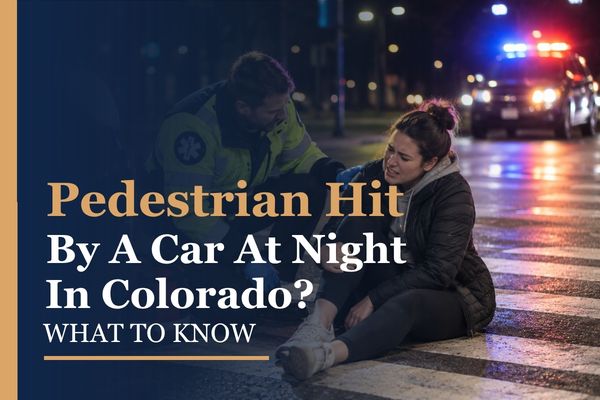
You were walking home, heading to a bus stop, or crossing a parking lot after work. It was dark, and a driver hit you.
Now you are hurt, and you may be hearing that it was your fault for being hard to see. This guide explains why crashes after dark happen, what Colorado law expects of drivers, and what you can do to protect a possible claim.
Why Are Pedestrian Crashes More Common After Dark?
Clocks in Colorado fell back an hour on November 1. That means many people now walk to work, school, or the store in the dark, both early in the morning and in the evening.
The Colorado Department of Transportation (CDOT) has tracked this pattern for years. On its pedestrian safety page, CDOT reports that 78 pedestrian deaths in 2024 happened when it was dark. That was 65% of all pedestrian deaths in the state that year. CDOT also says October and November stand out as Colorado’s deadliest months for people on foot.
In a September 2026 safety release, CDOT said nearly 60% of pedestrian deaths in Colorado over the past five years happened between September and February. The same release reported 131 pedestrians killed on Colorado roads in 2025, more than double the 64 killed in 2015.
The pattern is national, too. In its 2024 pedestrian data report, the National Highway Traffic Safety Administration (NHTSA) found that 76% of pedestrian deaths happened in the dark.
Does Being Hard to See Mean the Crash Was Your Fault?
Not by itself. Insurance companies often point to dark clothing or poor lighting. But Colorado law puts a clear duty on drivers.
Under C.R.S. 42-4-807, every driver must use due care to avoid hitting any pedestrian on any roadway. Drivers must also take proper care when they see a child or a person who seems confused or unable to get out of the way.
At night, that duty can mean slowing down, using headlights, watching crosswalks and bus stops, and keeping eyes off a phone. When a driver says, “I never saw them,” that may point to a driver who was not paying close enough attention.
Your own actions still matter. Where you crossed, what the signals showed, and what you could see may all come up. Colorado uses a shared fault system, and our guide to how comparative negligence affects Colorado car crash claims explains how fault can be split between people.
What Kinds of Night Crashes Hurt People on Foot?
NHTSA’s pedestrian safety guide lists common crash types between cars and people walking. Several of them get harder for drivers to avoid in low light:
- A driver turns at an intersection without yielding to someone in the crosswalk.
- A driver backs out of a driveway or parking space without looking.
- A person walks along a road with traffic coming from behind.
- A second car passes a car that stopped for someone crossing and hits that person.
Each of these can happen in daylight. At night, a driver who is speeding, distracted, or impaired has even less time to react.
What Should You Do After Being Hit While Walking at Night?
Your health comes first. Get medical care right away, even if you feel able to walk. Some injuries, like head injuries, may not show up clearly at first.
When you are able, these steps may help protect your claim:
- Call 911 and ask for police to come to the scene.
- Get the driver’s name, insurance, and plate number if it is safe to do so.
- Take photos of the scene, the lighting, the crosswalk, and any signals.
- Write down where you were walking and what you remember while it is fresh.
- Ask nearby businesses or neighbors if they have cameras that face the street.
- Keep the clothes and shoes you wore that night.
Lighting and camera evidence can fade fast. Many businesses record over video in days or weeks. Our article on what evidence helps build a strong Colorado car crash case covers this in more detail.
What If the Driver Left the Scene?
Hit-and-run crashes are a real concern for people on foot. NHTSA reports that nearly 1 in 4 pedestrians killed in 2024 were hit by drivers who fled.
If the driver drove away, call 911 and tell police everything you remember about the car. You may still have options through your own auto policy, depending on its terms. Learn more in our guide to hit-and-run crashes in Colorado.
How Long Do You Have to Act?
In Colorado, the deadline to file a lawsuit after a motor vehicle crash is generally three years. Some cases have much shorter deadlines. For example, if a government vehicle or a road problem played a part, a written notice may be due much sooner.
Because deadlines can vary, it is wise to talk with a lawyer soon after a crash.
How Can Julian Bendinelli Law Firm Help?
Bendinelli and his team of trial attorneys look at the scene, the lighting, and what the driver could have seen. They work to gather video, witness statements, and signal data before it disappears.
The firm prepares cases with a jury in mind. If an insurance company makes a fair offer, settling may be the right choice. If it does not, the firm is ready to take the case to trial when that is right for the client.
You can learn more on our pedestrian crash injuries page.
Talk With Julian Bendinelli Law Firm
If you or someone you love was hit by a car while walking at night, you do not have to sort it out alone. Julian Bendinelli Law Firm offers a free case evaluation with no upfront costs and no fees unless we win. Se habla español. Call or Text 24/7 at 303-720-6490, or request your free case evaluation.
Disclaimer :
“Nothing in this communication is legal advice. While general principles remain true, you must speak with an attorney to obtain legal advice that is tailored to your specific circumstances.”