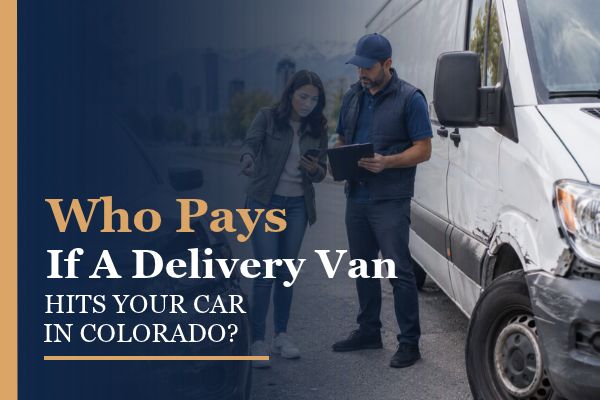
A delivery van ran a stop sign and hit your car. The driver was rushing to drop off holiday packages, and now nobody will tell you whose insurance should pay.
This is a common worry this time of year. More packages mean more vans on neighborhood streets, and a crash with a work vehicle can raise questions that a regular two car crash does not.
Who Is Responsible When a Delivery Van Hits You?
The short answer is that it depends on who the driver works for and whose vehicle and insurance were in use. A crash with a delivery van in Colorado may involve the driver, the company that hired the driver, and one or more insurance policies.
Here are the people and companies that may play a part:
- The driver, if careless driving caused the crash.
- The company that employs the driver, if the driver was working at the time.
- A delivery contractor or small business that runs routes for a larger company.
- The owner of the van, if it is different from the company that hired the driver.
Sorting out these roles early can make a big difference. The answer often decides which insurance company handles your claim.
Is a Company Responsible for Its Driver?
In many cases, a company may be held responsible for the careless driving of an employee who is doing their job. So if a delivery driver hits you while making deliveries, the claim may go through the company’s commercial insurance, not just the driver’s own policy.
There are limits. If the driver was off the clock or using the van for a personal errand, the answer can change. These details are often in dispute, which is why proof of what the driver was doing matters.
What If the Driver Is a Contractor?
Many deliveries today are made by contractors, not employees. Some large companies hire separate delivery businesses, and some drivers work for themselves using their own vehicles.
Contractor setups can be more complex. The company whose name is on the box may say it is not responsible. The contractor may have its own insurance. The driver’s personal policy may also come into play. Each setup is different, and the written agreements between the companies can matter.
Do not assume there is no coverage just because the first insurance company says no. A careful look at who controlled the work and the vehicle is often needed.
What Should You Do Right After the Crash?
Your health comes first. Call 911 if anyone is hurt, and get checked by a doctor even if you feel okay. Some injuries do not show up right away.
Then, if you can do it safely, gather details that can help later:
- The driver’s name, license, and phone number.
- The company name on the van and any van number or route number.
- The license plate and insurance details.
- Photos of both vehicles, the road, signs, and your injuries.
- Names and phone numbers of people who saw the crash.
- The police report number.
Our guide on what to do after a car crash in Colorado walks through these first steps in more detail.
What Evidence Helps in a Delivery Van Crash?
Delivery vans often carry technology that regular cars do not. Many companies track their vehicles and drivers. Helpful proof may include:
- GPS and route records that show where the van was and how fast it was going.
- Delivery app or scanner records that show whether the driver was working.
- Dash camera or in cab camera video.
- Doorbell or business cameras near the crash scene.
- The driver’s work schedule and delivery quotas.
This kind of evidence may not be kept forever. Video can be recorded over, and records may be deleted on a schedule. Our article on what evidence can disappear while you wait to file a claim explains why acting early matters.
Does Holiday Traffic Change Anything?
Holiday traffic does not change the law, but it can change the facts. Last year, ahead of Thanksgiving, CDOT warned drivers to expect more traffic as people travel and shop, and urged everyone to slow down, stay alert, and never drive distracted.
Busy delivery routes can lead to rushed driving, quick stops, and drivers looking at screens. If pressure to meet a delivery schedule played a part in your crash, that may be important to your claim.
What If You Were Partly at Fault?
The company or its insurer may try to blame you. Colorado uses a shared fault rule. Under C.R.S. 13-21-111, you may still recover damages if your share of fault is less than the share of the person or company you are making a claim against. Any money you recover is reduced by your share of fault.
You can learn more in our guide on how comparative negligence affects Colorado car crash claims.
How Can Julian Bendinelli Law Firm Help?
Crashes with company vehicles often involve large insurers and many moving parts. Bendinelli and his team of trial attorneys look into who employed the driver, whose insurance applies, and what the company’s own records show.
The firm prepares every case as if it may go to a jury. When a fair offer comes, settling may make sense. When it does not, the firm is ready to try the case if that is right for the client. Learn more on our car crash injuries page.
Talk With Julian Bendinelli Law Firm
If a delivery van hit you in Colorado, you do not have to sort out the companies and insurers on your own. Julian Bendinelli Law Firm offers a free case evaluation. Se habla español. Call or Text 24/7 at 303-720-6490, or request your free case evaluation.
Disclaimer :
“Nothing in this communication is legal advice. While general principles remain true, you must speak with an attorney to obtain legal advice that is tailored to your specific circumstances.”