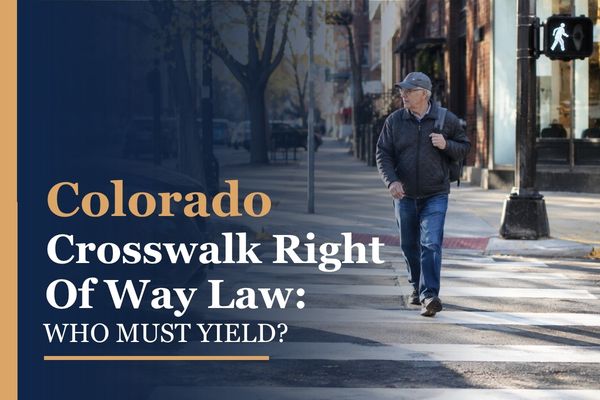
A driver hit you while you were crossing the street. Now the driver says you should have waited, and the insurance company seems to agree.
Who had the right of way? In Colorado, the answer depends on where you crossed, what the signals showed, and how carefully the driver was watching. This guide walks through the basic rules in plain words.
What Does Colorado Law Say About Crosswalks?
The main rule is in C.R.S. 42-4-802. When there are no working traffic signals, a driver must yield to a person crossing in a crosswalk. The driver must slow down or stop if needed. This applies when the person is on the driver’s half of the road, or is coming from the other half so closely that they are in danger.
The law also says a driver may not pass another car that has stopped at a crosswalk to let someone cross. This matters because a stopped car can block the view of a person stepping into the next lane.
CDOT’s pedestrian information page adds a helpful point. Pedestrians have the right of way in crosswalks and intersections when signals show it is safe to cross, even if there are no painted lines on the road.
What Is an Unmarked Crosswalk?
Many people think a crosswalk only exists where there are painted stripes. That is not always true. Colorado law refers to both marked crosswalks and unmarked crosswalks at intersections.
In simple terms, an unmarked crosswalk is often the natural path across the street at a corner, where the sidewalk would continue if it were drawn across the road. Whether a spot counts as a crosswalk can become an important question in a claim.
What Do Walk and Don’t Walk Signals Mean?
Section 42-4-802 also explains pedestrian signals:
- A steady Walk signal means people facing it may cross, and drivers must give them the right of way.
- A steady Don’t Walk signal means people should not enter the road in that direction.
- A flashing Don’t Walk signal means people should not start crossing. But anyone already partway across should keep going to the sidewalk or a safety island, and drivers must yield to them.
That last rule protects people who started crossing on time but did not finish before the signal changed. NHTSA lists this as a common crash type, where a person is still in the crosswalk when the light changes and a car fails to yield.
When Must a Pedestrian Yield to Cars?
The rules go both ways. Under C.R.S. 42-4-803, a person crossing outside a marked crosswalk, or outside an unmarked crosswalk at an intersection, must yield to vehicles on the road.
The same law says that between two nearby intersections with working traffic signals, people may only cross in a marked crosswalk. Section 42-4-802 also says a person should not suddenly step off a curb into the path of a car that is too close to stop.
This matters because many crashes do not happen in crosswalks. CDOT reports that 68% of pedestrian deaths in Colorado in 2024 happened outside of crosswalks.
Does Crossing Outside a Crosswalk End Your Claim?
Not always. Even when a person on foot should have yielded, drivers still have a duty to watch out for people. Under C.R.S. 42-4-807, every driver must use due care to avoid hitting any pedestrian on any roadway.
Colorado also uses a shared fault system. Under C.R.S. 13-21-111, an injured person can still recover damages if their share of fault is not as great as the fault of the person they are seeking money from. Any damages are reduced by the injured person’s share of fault. If the injured person’s fault is equal to or greater than the other side’s, they cannot recover. Our guide to how comparative negligence affects Colorado car crash claims explains this rule in more depth.
So the question is often not only “Who had the right of way?” It may also be “How careful was each person?” Speed, distraction, lighting, and how much time the driver had to react can all matter. Our guide on what to do if the other driver blames you for the crash explains more about blame disputes.
What Evidence Can Show Who Had the Right of Way?
Right of way disputes often come down to proof. Helpful evidence may include:
- Traffic camera, business camera, or doorbell camera video.
- Dash camera footage from the driver or other cars.
- Statements from people who saw the crash.
- Signal timing and whether the crossing button worked.
- Photos of crosswalk lines, signs, and street lighting.
- The police report, though it is not always the final word.
Some of this evidence disappears quickly. Video may be recorded over, and memories fade. Acting soon can make a real difference.
How Can Julian Bendinelli Law Firm Help?
Bendinelli and his team of trial attorneys investigate pedestrian crashes from the ground up. They look at the scene, the signals, and what the driver could see, instead of relying only on the driver’s story.
The firm prepares every case as if it may go to a jury. When a fair offer comes, settling may make sense. When it does not, the firm is ready to try the case if that is right for the client. You can read more on our pedestrian crash injuries page.
Talk With Julian Bendinelli Law Firm
If you were hurt in a crosswalk or while crossing a Colorado street, you deserve clear answers. Julian Bendinelli Law Firm offers a free case evaluation with no upfront costs and no fees unless we win. Se habla español. Call or Text 24/7 at 303-720-6490, or contact our team.
Disclaimer :
“Nothing in this communication is legal advice. While general principles remain true, you must speak with an attorney to obtain legal advice that is tailored to your specific circumstances.”